

Meet the Breeder: A Bit About Me and My Dogs
Hi, I am Alina Varga—founder of Snooze & Sniff, mom to Marley and baby Jaxon, and a passionate Australian Labradoodle breeder with nearly a decade of experience.
I live just outside Seattle on a quiet piece of land where my kids play barefoot, our garden feeds us most of the year, and our dogs run free in the fields like they are part of the family—because they are.
Breeding Australian Labradoodles is not just my work. It is how I live. Over the years, I have helped hundreds of families find the dog that completes their home—and the one thing I always come back to, above all else, is temperament.
Looks fade. Puppy energy mellows. But temperament? That stays.
In this article, I want to give you the kind of honest, experience-based insight you do not always get from breed guides or social media posts. If you are wondering what Labradoodles are really like—not just in theory, but in day-to-day life—this is for you.
The Origin of the Australian Labradoodle – And What That Means for Temperament
When people hear “Labradoodle,” they usually think of a cross between a Labrador Retriever and a Poodle. That is partly true—but the Australian Labradoodle is something more intentional, and far more refined.
This breed began with the goal of creating an allergy-friendly service dog. The original foundation combined the Labrador’s people-pleasing nature with the Poodle’s intelligence and low-shedding coat. But breeders did not stop there. Over time, other breeds like the English Cocker Spaniel were introduced—not for looks, but to fine-tune temperament: softness, stability, and emotional intelligence.
At Snooze & Sniff, we work with multigenerational Australian Labradoodles, which means they are not first-generation crosses. These are dogs carefully bred over several generations for predictability, balance, and purpose. Their temperament is not a gamble—it is a result of long-term work by dedicated breeders.
This thoughtful breeding shows up in daily life. It is why so many of our dogs go on to work in therapy and emotional support roles, or become trusted companions to families with young children, neurodiverse kids, or seniors who want a dog that just “gets them.”
📌 Alina’s Note: When someone asks me what makes a Labradoodle special, I tell them this: “You are not just getting a dog that is smart—you are getting one that is wired to connect.”
Find Your New Family Member!
Explore the world of Snooze and Sniff’s Australian Labradoodles, where premier breeding meets loving care. Our program focuses on nurturing intelligent, well-tempered puppies, ready to become a joyful part of your family.


The Intelligence Factor: Smart, Trainable, and Intuitive
One thing you notice right away with Australian Labradoodles is just how quickly they get things. They are not only smart—they are tuned in, reading body language, tone, and routines faster than most people expect from a young dog.
As a breeder, I see this intelligence at play from the earliest weeks. By the time our puppies are 5 to 6 weeks old, they have already figured out how to sit for attention, follow basic lures, and recognize our voices. They thrive on interaction and problem-solving—whether it is figuring out how to open a puzzle toy or learning where to wait before heading outside.
This intelligence makes them a joy to train. They respond incredibly well to positive reinforcement—not just because of the treats, but because they genuinely want to please. They learn quickly, retain commands with very little repetition, and often surprise their new families by picking up routines within the first week home.
But intelligence can be a double-edged sword if it is not guided. Without structure, Labradoodles may invent their own routines—like helping themselves to the laundry basket or outsmarting baby gates. That is why I always recommend combining mental stimulation with clear expectations from the start.
Whether you are teaching sit, stay, or something fun like shake or spin, Labradoodles do not just perform—they engage. They look into your eyes, wait for the cue, and try to understand what is being asked. And to me, that is the mark of a truly special dog.
📌 Alina’s Note: Smart dogs need smart handling—and Labradoodles will rise to whatever standard you set, as long as you do it with patience and kindness.
The Bond of Affection: Labradoodles as Family Companions
The Bond of Affection: Labradoodles as Family Companions
If I had to describe Australian Labradoodles in one word, it would be connected. These dogs do not just live in your home—they live in your heart. They want to be near you, part of your day, involved in the little moments that make up family life.
Whether it is following you from room to room, curling up at your feet while you work, or sitting patiently next to your toddler on the floor, their presence is constant—and intentional. Labradoodles are the kind of dogs that look you in the eyes and feel with you. They know when you are stressed, when the kids are wound up, or when it is time to just settle in for a quiet evening.
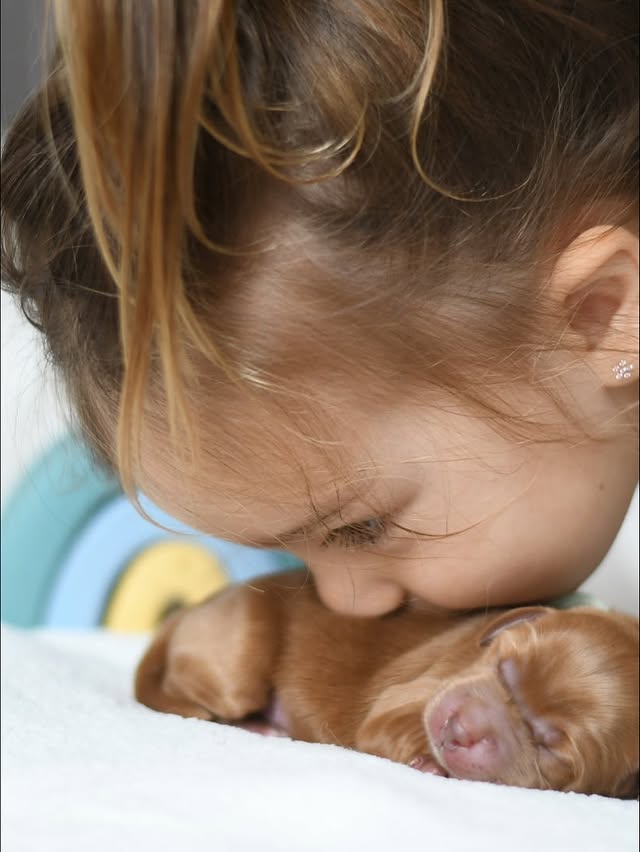
I have watched countless families experience this bond for the first time. The moment a child lays their head on a puppy’s back. The way a Labradoodle instinctively lies still next to an anxious adult. These dogs do not just love—they offer comfort in ways that are hard to explain but easy to feel.
This affectionate nature is what makes them such a perfect match for:
Children of all ages
Families with special needs
Empty-nesters looking for companionship
Multi-pet homes (they integrate beautifully with cats and other dogs)
But they are not clingy. With the right foundation, Labradoodles can be left alone, travel well, and adapt to change. They are affectionate without being needy—and that is a rare balance to find in any breed.
📌 Alina’s Note: When I place a puppy, I am not just thinking about how it will behave—I am thinking about how it will connect. Because at the end of the day, the deepest joy of having a Labradoodle is the bond they build with you.
Emotional Sensitivity: A Strength That Needs the Right Environment
One of the most unique and beautiful things about Australian Labradoodles is how emotionally sensitive they are. I do not mean fragile—I mean in tune. These dogs pick up on your energy, your tone, and even the atmosphere in your home. They respond to emotions in a way that still surprises me, even after all these years of breeding.
This emotional awareness is a big part of why they are so well-suited for therapy work, schools, and support roles. But it also means they need an environment that values calm leadership, positive reinforcement, and connection over control.
Labradoodles do not respond well to yelling, harsh corrections, or inconsistent routines. They will shut down, get anxious, or start guessing what you want instead of building confidence. That is why I always remind new families: it is not about being a perfect trainer—it is about being a consistent, kind guide.
We start shaping this balance early—right from the whelping box. Our puppies are exposed to gentle handling, new experiences, and calm human interaction from the very beginning. That early trust helps them grow into confident, emotionally stable dogs who can adapt to all kinds of homes and lifestyles.
📌 Alina’s Note: Their sensitivity is not a weakness—it is what makes them so in tune with the people they love. The key is raising them in a way that lets that softness shine.
The Breeder’s Role in Fostering a Good Temperament
People often ask me, “Are Labradoodles naturally this sweet?” And while the breed is known for its balanced personality, the truth is—temperament does not happen by accident. It is the result of consistent, thoughtful breeding and early-life care that begins long before the puppy ever meets its new family.
As a breeder, I take that responsibility seriously. The work we do in the first 8 weeks of life is foundational. It sets the tone for how a puppy responds to stress, how confident they are around people, and how easily they adjust to new environments.
At Snooze & Sniff, we raise every litter inside our home. That means our puppies hear the vacuum, the blender, the doorbell. They are handled by adults and kids (under supervision). They experience touch, sound, movement, and change in a safe, structured way.
We also follow a puppy enrichment plan that includes:
Early Neurological Stimulation (ENS)
Exposure to different surfaces, textures, and smells
Age-appropriate social challenges (tunnels, gentle grooming, climbing steps)
Intentional quiet time and crate introduction to build independence
All of this is done with gentleness and intention. We are not just raising “cute puppies”—we are shaping dogs who can handle the world with calm curiosity and emotional balance.
📌 Alina’s Note: Good temperament starts with good breeding—but it is the hands-on, in-home work that brings it to life. That is the part I love most about what I do.
Ethical Breeding and Why It Matters So Much
There is a lot of talk about “ethical breeding,” but not everyone understands what it truly means—or how much it affects a dog’s temperament.
For me, ethical breeding starts with intentionality. Every pairing I choose is based on more than looks. I am considering genetics, health history, temperament, and how those two dogs complement each other emotionally. It is never about producing puppies quickly—it is about producing them well.
We follow strict health testing for all our parent dogs:
Hips and elbows (OFA or PennHIP certified)
Eyes (annual exams by veterinary ophthalmologists)
Full DNA panels to rule out inherited diseases
But health is only part of the picture. The other half is emotional genetics—that calm, gentle, people-loving personality that is passed down just like coat type or eye color. When you work with carefully chosen lines, you start to see consistency. Puppies grow up to be just like their parents: intuitive, grounded, and easy to live with.
📌 Alina’s Note: Ethical breeding is not a trend—it is a long-term commitment to doing right by the dogs, the families, and the future of the breed.
Every Puppy Is Unique – But Patterns Matter
No two Labradoodle puppies are exactly alike—and I would not want them to be. Some are bold and curious from the start. Others are softer, more reserved, more thoughtful. That is part of what makes my job so rewarding: learning each puppy’s personality and helping it shine in the right home.
But after nearly 10 years and dozens of litters, I have learned to recognize patterns. When you work with strong, multigenerational lines and raise puppies in a consistent, enriching environment, temperament becomes predictable in all the best ways.
We use temperament evaluations around 7 weeks to assess:
Confidence in new situations
Curiosity and recovery after mild stress
Sensitivity to sound and touch
Sociability with humans
Energy levels and focus
This helps me place a playful, outgoing pup with an active family—and match a gentler, emotionally aware dog with a quieter household or even a therapy setting.
Some of my favorite memories come from those pairings:
The child with sensory challenges who finally connected with a dog that just understood.
The couple who wanted a calm, trainable companion after retiring.
The schoolteacher whose Labradoodle became her classroom reading buddy.
📌 Alina’s Note: Every puppy has its own story—but when you understand the patterns behind temperament, you can write those stories with intention, not guesswork.
Is an Australian Labradoodle Right for You?
Australian Labradoodles are incredibly versatile—but they are not the right fit for everyone, and that is okay. What matters most is that you are choosing a dog whose temperament fits your lifestyle—not just one with a cute face or trendy coat.
This breed thrives in homes where they are:
Included in daily life—not left alone for long hours.
Given consistent structure and gentle guidance.
Mentally and physically engaged (walks, play, puzzles, training).
Treated like family—not a backyard fixture or a decoration.
That does not mean you need to be a dog expert or have a huge house. Labradoodles do just as well in apartments as they do on farms—what they really need is connection, patience, and presence.
They are a great match for:
First-time dog owners
Families with children (young or older)
Singles or couples wanting an emotional companion
Retirees looking for a well-mannered, affectionate dog
Homes seeking a potential therapy or emotional support animal
But if you are looking for a breed that is content being left alone for most of the day, or a dog that responds well to harsh corrections, a Labradoodle might not be the right fit.
📌 Alina’s Note: If you are someone who wants a dog that listens, learns, loves deeply, and becomes part of the rhythm of your life—then yes, this breed might just be everything you are looking for.
Final Thoughts From Me
Every time I watch one of our puppies meet their new family, I still get a lump in my throat. Even after all these years, that moment never gets old. It is more than a handoff—it is the start of something real. A bond that will grow over walks, shared routines, silly habits, and quiet moments on the couch.
That is why I care so deeply about temperament. Because what matters most is not whether a dog can sit on command—it is whether they show up in your life the way you need them to. Whether that is to be your child’s best friend, your emotional anchor, or just the quiet presence by your side after a long day.
Raising Australian Labradoodles is not just a job for me—it is something I live and breathe. Our dogs grow up with my kids, play in our yard, nap on our kitchen floor. They leave our home already knowing what love feels like—and they carry that into yours.
So if you are thinking about this breed and wondering if it is right for you, I hope this gave you a clearer picture. And if you have questions, reach out. I am always happy to talk dogs.
With heart,
Alina Varga, Founder of Snooze & Sniff
Mom. Breeder. Dog matchmaker.



Snooze and Sniff's expertise extends beyond breeding into educating and assisting paw parents with their Australian Labradoodle's care through our informative blog. With extensive knowledge in canine health, behavior, and training, we provide valuable insights and guidance to ensure your dog thrives in its forever home.
